
An Account Executive at an insurance company in Des Moines opens Excel on Monday morning. PTO tracker, twenty minutes. Invoice reconciliation, forty-five minutes. Claims backlog, an hour, because the spreadsheet has three tabs that should be one and nobody knows who built it. Client list. A chart for tomorrow’s meeting.
Four hours. Every Monday. Fifty weeks a year.
AI does all of it in about two minutes. Not future AI. The button that’s already in their Excel toolbar.
That same AI, the version that came out a few weeks ago, can now complete a software engineering task that would take a person 14 hours. The kind of task that gets assigned to someone at Google who has a master’s from MIT. Complex, independent work, like holding an entire codebase in your head while debugging something that breaks three systems downstream.
Two minutes on your Monday spreadsheet. Fourteen hours of the work Google pays half a million for. Same technology.
So it can do everything?
You used to be able to ask that kind of question.
When you were five, you asked these kind of questions all the time. What if the building went to space? What if dogs could talk? What if I never stopped growing? You weren’t embarrassed by any of them. You hadn’t learned to be.
Then you got twenty-odd years of linear. A 3% raise every year. A mortgage payment that’s the same every month. 25 minute commute today and it’ll be 25 minutes tomorrow. Everything in adult life teaches the same lesson: tomorrow looks roughly like today, plus or minus a little.
That training is useful. It’s how you budget. How you plan. How you stay sane. It’s also dead wrong when something exponential shows up, and you don’t experience it as being wrong - you experience it as being reasonable.
A kid hasn’t accumulated thirty years of “reasonable” yet. Show them a line going up and they say “does it keep going?”
What if it goes up forever?
There’s a nonprofit called METR that measures one thing: how long of a task can AI complete? They give AI agents real software engineering work, the same tasks they’d give human engineers, and measure at what task length the AI succeeds half the time.
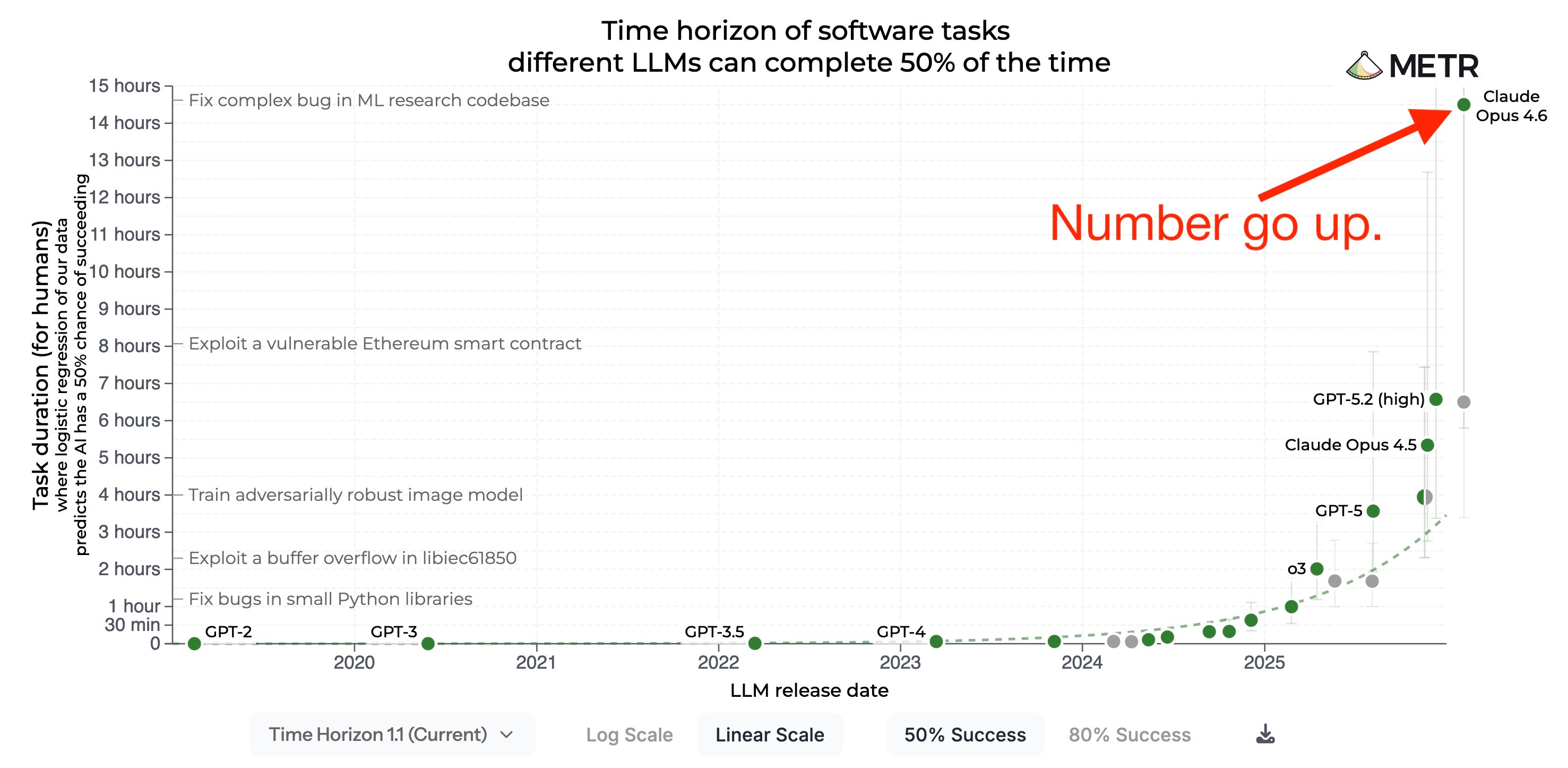
In early 2024, the answer was 30 minutes. By mid-2025, a couple hours. By December, five hours. Then last week, METR tested Claude Opus 4.6.
Fourteen hours. A full workday plus overtime.
METR tested whether this trend fits a straight line or an exponential curve. The exponential wins. They tested whether it’s slowing down. No sign of it. Across every model generation, from every major lab, the curve holds.
Now do the thing your brain doesn’t want you to do. Follow the line forward twelve months. Where does it land?
Whatever number you just came up with, notice what happened in your chest. That tightness. That impulse to add “well, assuming the trend holds…” or “there are reasons to think it might plateau.”
The five-year-old would just say where the line goes.
Your Monday
So look at your actual life. Not the abstract future. Your Monday.
Maybe you’re a lawyer. “Sure, it reads contracts. But clients pay me because I read the room.”
Maybe you’re a doctor. “It can pass the boards. But medicine is the patient in front of you. The tremor in their voice. Knowing when they’re not telling you something.”
A meta-analysis published last October looked at fifteen separate studies across cancer care, mental health, surgery, and general medicine. Patients rated AI responses higher than their doctors'. Not on accuracy. On empathy. In the largest study, AI responses were rated empathetic ten times more often than the doctors' responses. Fifteen studies. Wasn’t even close.
You felt that one. Your brain is already reaching for reasons it “doesn’t count”. “Text isn’t real empathy.” “That’s not the same as sitting with someone.”
Wouldn’t it be silly if empathy was just another skill it learns? The same way it learned to write code. Then learned to reason. Then learned to work fourteen hours straight without supervision.
Two years ago, code was the “yeah but.” A year ago, reasoning. Six months ago, working independently. The line ate all of them. Empathy is standing in the same spot they were standing.
The Quiet Part
Here’s what just happened while you read that last section. You followed the line. You saw where it goes. And then some part of you started composing the email you’d never actually send. “I’ve been looking at the METR data and I think we need to fundamentally rethink...” No. Delete that. Too crazy. People would talk.

Everyone in your industry has done this math privately. In the shower. Late at night. They’ve followed the line. They allow themselves to feel where it goes. They won’t say it on Monday.
Because saying “AI will be able to do my entire department’s job somewhere in between Halloween and Thanksgiving” in a meeting has the same social cost as saying you saw a UFO. Your colleagues look at you funny. Your boss questions your judgment. Being wrong about a conservative prediction is forgettable; being wrong about a wild one follows you around.
So smart people sandbag. “Interesting trend, but there are reasons to think it might plateau.” They don’t believe that. They’re managing their reputation. And when everyone sandbags at once, the consensus becomes the cautious prediction even though nobody in the room actually holds it privately.
The cognitive barrier is real, but you can fix it with a chart. I just showed you one. You followed the line. That part is done.
The status barrier is worse because it’s invisible. The fear disguises itself as professionalism.
Look at the chart one more time. Follow the line forward twelve months. Whatever number you land on, notice what your brain does next. The tightness. The urge to qualify.
A silly goose would just say where the line goes.
Great essay, Dave. Love these insights.
A few things here Dave, I speak as a software developer of 40+ years, who is named inventor of a number of software patents. I also make frequent use of AI coding tools in my day to day work
The measure of 50% success in completion seems weak, they state in their paper that expectations of 80+% success does not succeed due to unreliability.
Their human comparators have just 5 years experience, which seems too low when comparing against AI models which have devoured every public GitHub repo and every Stack overflow post. Expecting top 100 universities be a nursery for good coders does not match my experiences but that is just my own bias (PhDs man…)
The big issue in my view is the limitations of LLMs when coding.
The knowledge window that is 6 months out of date when released. So six months of zero day exploits lurking in the platforms and modules that the model has chosen
The propensity of the models to fiddle with sections of the code that have no bearing to the bug that is being fixed. If an engineer of moderate experience submitted a pull request that arbitrarily change other parts of the code base then it would be a quick trip to a private room for a dressing down.
Which leads be to the fact that LLM don’t learn from their mistakes. The coder I bollocked for their shabby PR probably won’t make that mistake again. A LLM coding model? almost definitely.
The time gap for production level problem completion caused by all the above should factor in all of the above.
Cheers,
Chris