
Last week I published an essay called “You Need to Be More of a Silly Goose.” The argument: AI capability keeps doubling on a smooth exponential. Smart people follow the line, see where it goes, and reach for reasons it can’t continue.
A reader named Chris McKay pushed back in the comments. Forty-plus years shipping software. Named inventor on multiple patents. Uses AI coding tools every day. He raised three objections to the METR data I referenced (measurements of how long AI can complete real tasks without supervision): a. how the 50% success threshold is weak, b. the humans they tested against only have five years of experience, and c. LLMs can’t learn from their mistakes.
All three are legitimate observations. Chris sees AI models touch unrelated code, spin out in to incoherence, and reaches a reasonable conclusion. His skepticism comes from experience, not ignorance.
Then he wrote: “you are my counterpoint to Gary Marcus who is also a good read.”
For the uninitiated, Gary Marcus is a cognitive scientist, NYU professor, and probably the most prominent AI skeptic on the internet. Millions of followers. Gary Marcus has been documenting what’s broken with AI - things like what Chris referenced - since before ChatGPT launched.
I’ve spent the last six months reporting on the same failures as Gary. Models that solve PhD-level physics and can’t count line crossings in an image; GPT-5 helping a Fields Medalist prove theorems one week and inventing fake academic references the next. Marcus and I are looking at the exact same broken stuff.
The disagreement between Gary Marcus on myself is: are these failures permanent, or temporary? Marcus says permanent. I say temporary.
Chris is standing between those two interpretations. So: I did the math.
How Did I do the Math?
I downloaded all 474 of Marcus’s Substack posts from May 2022 through February 2026. Two independent AI extraction pipelines (Codex and Claude Code, working in parallel) read every post, pulled every testable claim, and scored each one against available evidence as of March 2, 2026. 2,218 claims total, each scored for falsifiability on a four-point checklist: clear subject, measurable prediction, timeframe, and threshold. Claims were clustered into 54 recurring themes and analyzed for repetition patterns, goalpost movement, and trajectory over time.
You can view the code here:
https://github.com/davegoldblatt/marcus-claims-dataset
What did I find, but…
Gary Marcus is right 60% of the time!
That 60% is not the number most people expect. Looks like Gary is a better analyst than his critics assume.
Two claims from 2024 show where the 60% hides the interesting stuff:
Marcus wrote that OpenAI’s Superalignment team never got the 20% of compute it was promised. He was right. Both Jan Leike and Ilya Sutskever confirmed it when they left. OpenAI gutted its safety team while claiming safety was its core mission. Marcus called it.
Same year, Marcus wrote: “I fully expect that the generative AI bubble will begin to burst within the next 12 months.” Twelve months later, OpenAI raised at a $300 billion valuation and Nvidia hit a record market cap.
He nailed the institutional betrayal. He completely missed the money. If you followed his first call, you understood OpenAI better than most insiders. If you followed his second call, you sat out the biggest capital deployment in a generation.
Same analyst, same year, same confidence. That split runs through the entire dataset.
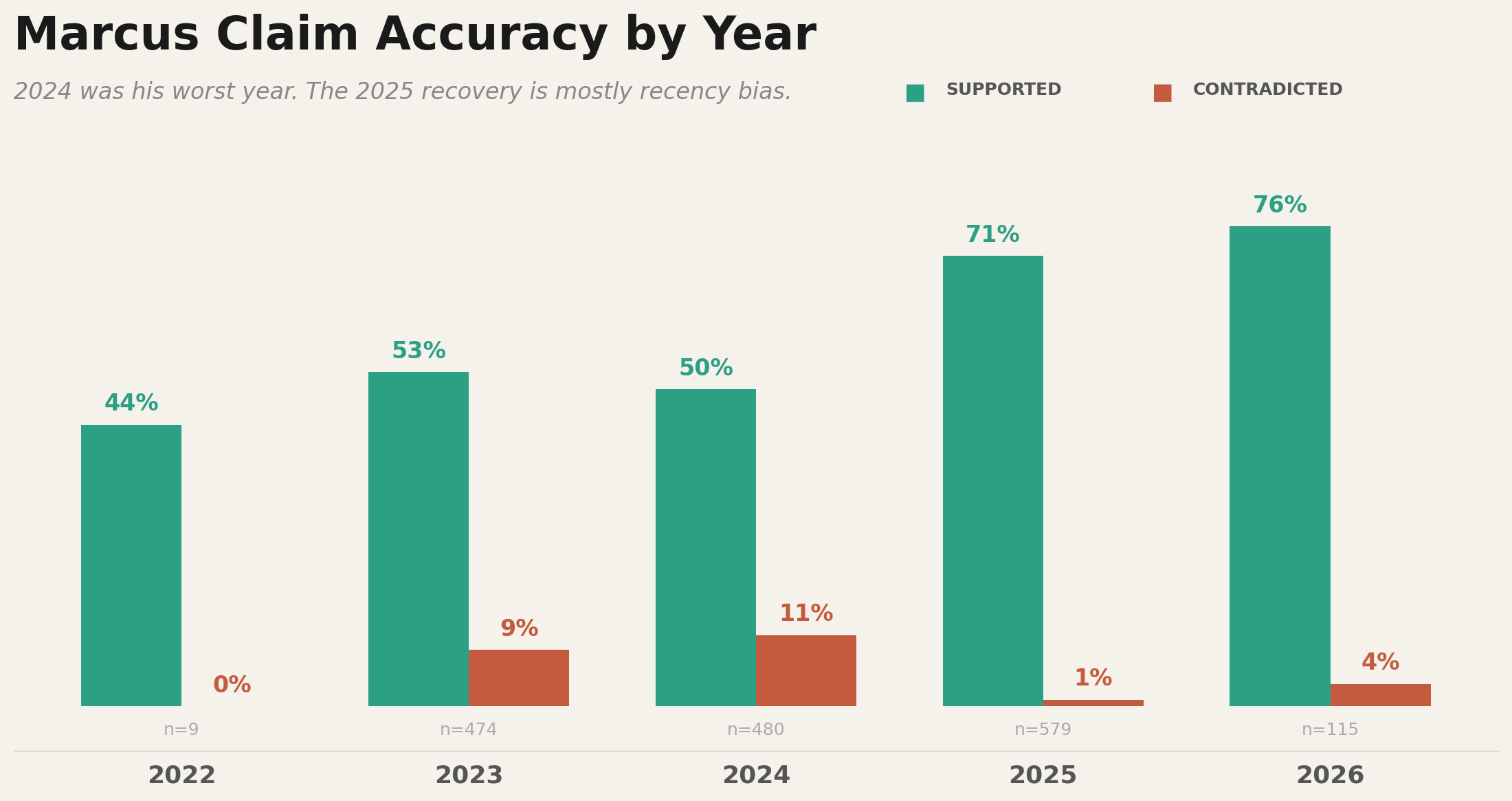
2024 was his worst year. OpenAI released o1 (their first reasoning-focused model) in late 2024, and it contradicted a batch of Marcus’s absolute claims about what AI could and couldn’t do. His contradiction rate hit 11%, the highest of any year. Then he adapted. By 2025, his supported rate jumped to 71% and contradictions nearly vanished.
But wait, is he getting better post 2024? That recovery is probably a measurement artifact.
When you break accuracy by how old the claim is relative to our evaluation date of March 2, 2026, a different pattern appears:
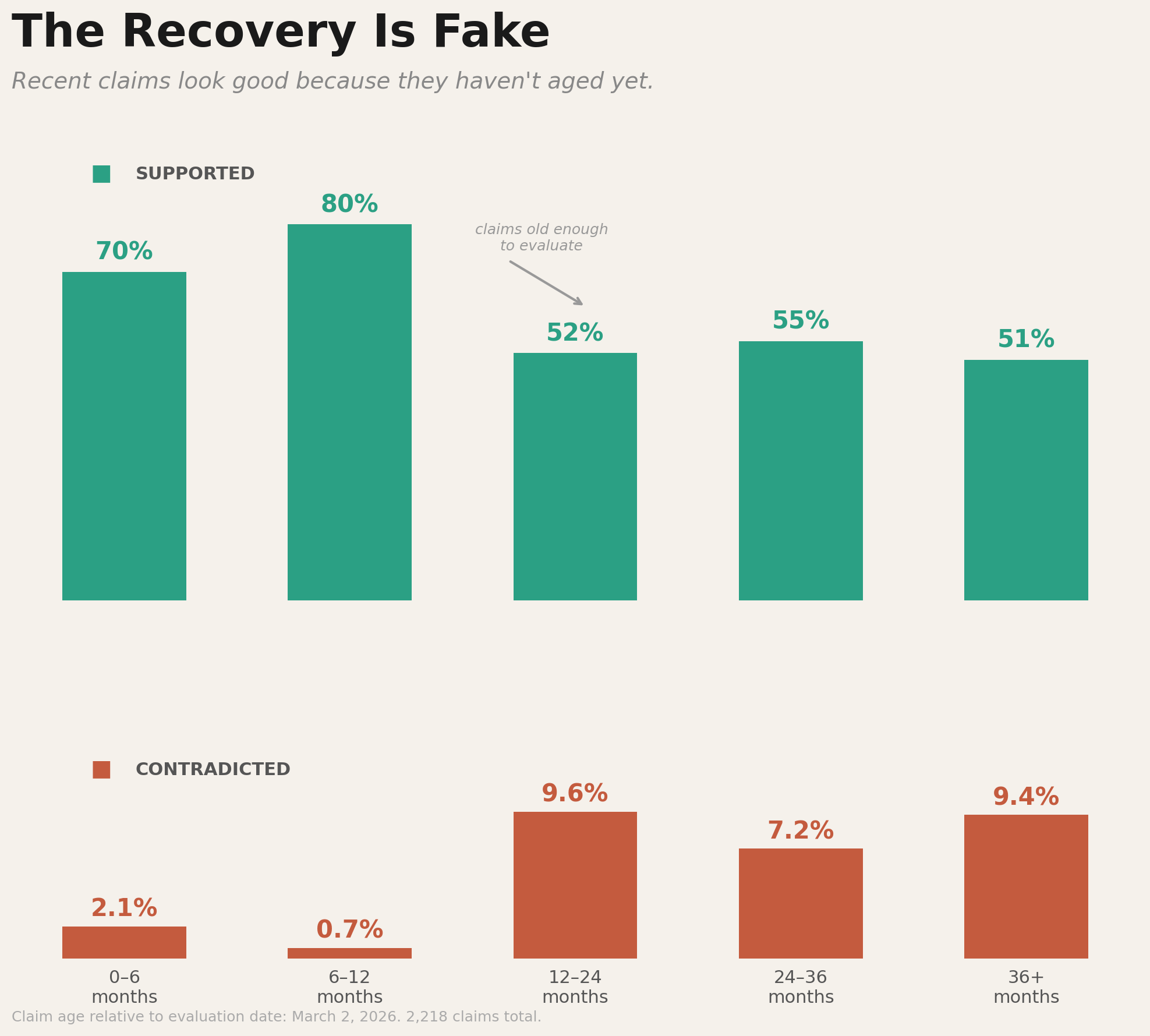
Claims from the last year look great. Claims from two or more years ago look mediocre. The difference being; a claim Marcus made in January 2025 hasn't had time to age badly yet. A claim from 2023 has had three years of evidence piling up against it. Our AI grader treated “no evidence against it yet” the same as “correct.”
Marcus says LLMs match surface patterns without understanding deeper structure. Funnily enough, the tool built to measure the critic has the flaw the critic describes. Score one for Gary?
Net/Net: Strip out recency bias and Marcus’s real accuracy on claims old enough to evaluate credibly is a stable ~52% supported, ~8% contradicted. Not great, not terrible. Roughly a coin flip.
Our Diagnosis Overlaps; Our Conclusion Doesn’t
Marcus’s hallucination cluster (AI making stuff up) scores 56.7% supported. His AI security vulnerability claims score 100% supported on the ones that can be checked. His observations about brittle, uneven capabilities track the data I’ve been reporting on for six months. We’re looking at the same broken stuff.
The disagreement is about what broken means.
Marcus says “architectural.” The failures are baked into how these systems work. Hallucination persists after four years and three generations of models getting bigger and more expensive. No production system has eliminated it. Security vulnerabilities haven’t budged. If these are the only numbers you check, his interpretation wins.
If the limitations are developmental, though, you’d expect AI to keep stumbling into new domains where it works despite the problems. Last December, a grad student at MIT designed novel proteins using off-the-shelf ChatGPT with no specialized training, made them in an actual lab, and 91% folded into the shape they wanted. A few hours of compute and the tool that supposedly can’t reason was doing drug discovery.
Meanwhile the price of asking an AI a question dropped 48x in five years. At those prices you don’t need a model that never hallucinates. You need one cheap enough to run three times and check its own work, which is where we are right now.
Reasoning is harder to call. Marcus softened “LLMs can’t reason” to “can’t reason reliably” over four years, and he has a point, the models still misfire when deciding which problems need careful thought. But an OpenAI study had industry veterans with 14 years average experience design tasks from their actual jobs, and Claude scored 47.6% against human experts’ 50%. That’s a lot of misfiring that still gets the answer right.
The data doesn't settle architectural versus developmental across the board. Some failures - like hallucination - have barely budged in four years, which looks permanent. Some failures persist, but the cost of working around them keeps dropping, which looks temporary.
The permanent-versus-temporary debate could run for years (and probably will). The data answers a more useful question right now: where is Marcus's judgment trustworthy, and where does it break down?
The Pundit Trap
The internet knows Marcus as “the LLMs can’t reason guy.” His most accurate work has nothing to do with that.
His sharpest calls are the specific technical ones. LLMs have security holes. Sora’s video output is unreliable. AI agents aren’t ready for production. Evidence backs him 88% to 100% across those clusters, with zero contradictions. When Marcus points at a specific broken thing and says “that’s broken right now,” he’s nearly perfect.
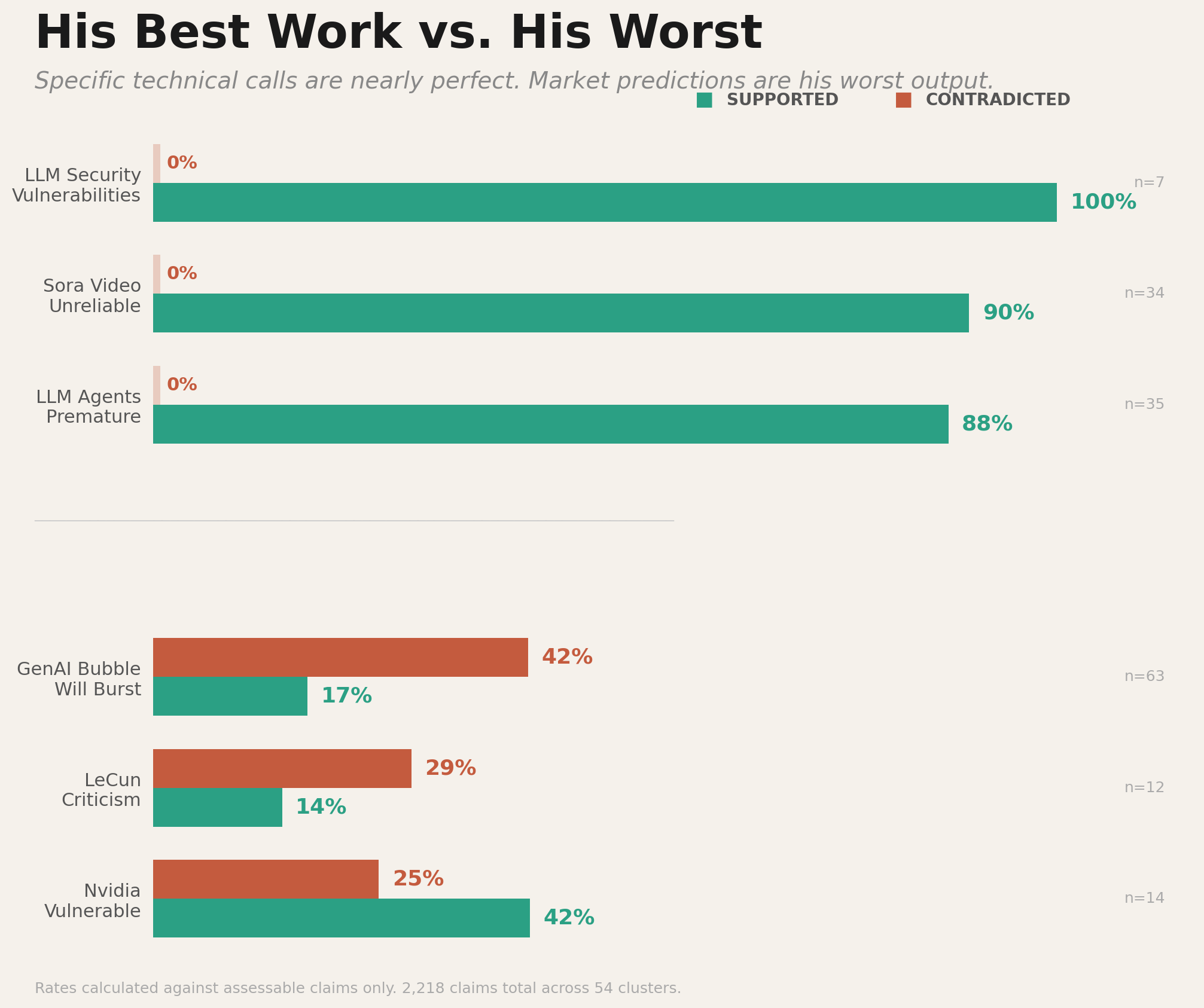
His market predictions are a different (much worse) animal. “GenAI bubble will burst” is his single worst theme across all 54 clusters, with 27% of those claims directly contradicted by evidence. His claims about Nvidia being vulnerable aren’t far behind at 21.4% contradicted. February 2026: “Turns out Generative AI was a scam.” A week later: “The whole thing was a scam.” Three years of escalation, still waiting on that crash.
His “bubble” thesis gets harder to sustain every time a limitation proves temporary, because each limitation that falls in turn justifies more of the spending. And the spending is already paying for itself. Hyperscaler return on invested capital (the profit they earn relative to what they’ve spent) is higher now than before the GPU spending surge began.
So why is his best work invisible and his worst work famous?
Falsifiability. We scored every claim for whether evidence could prove it wrong: clear subject, measurable prediction, timeframe, threshold. 12.7% passed all four. 18.8% passed none. Nearly a fifth of his output is structured so that no outcome could contradict it.
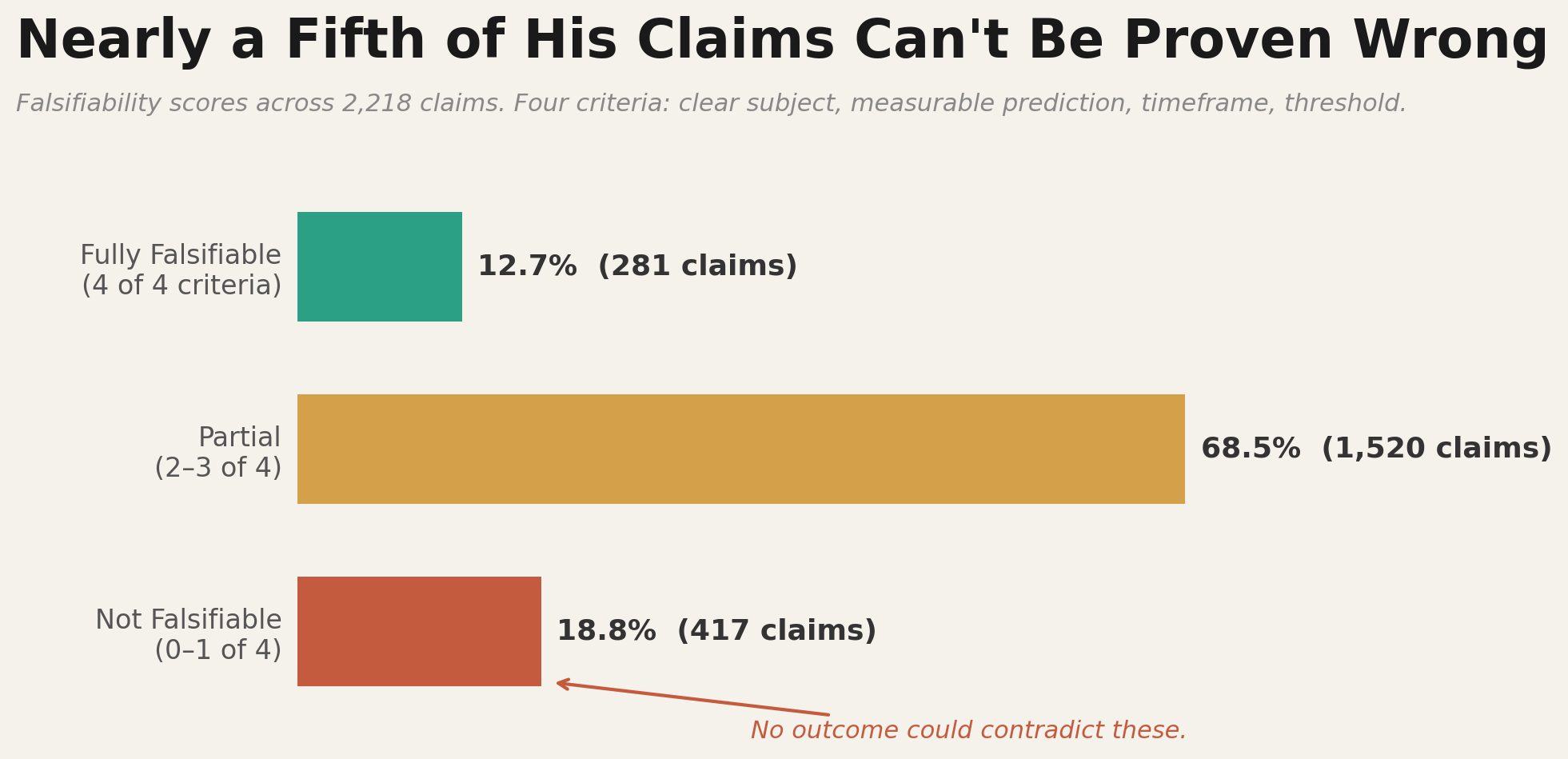
“OpenAI promised 20% of compute to safety and didn’t deliver.” That’s specific. It resolves, gets confirmed, and doesn’t generate follow-up posts because there’s nothing left to say. “The whole thing is a scam” has no deadline, no threshold, no failure condition. Marcus can write about it every month (and he does.)
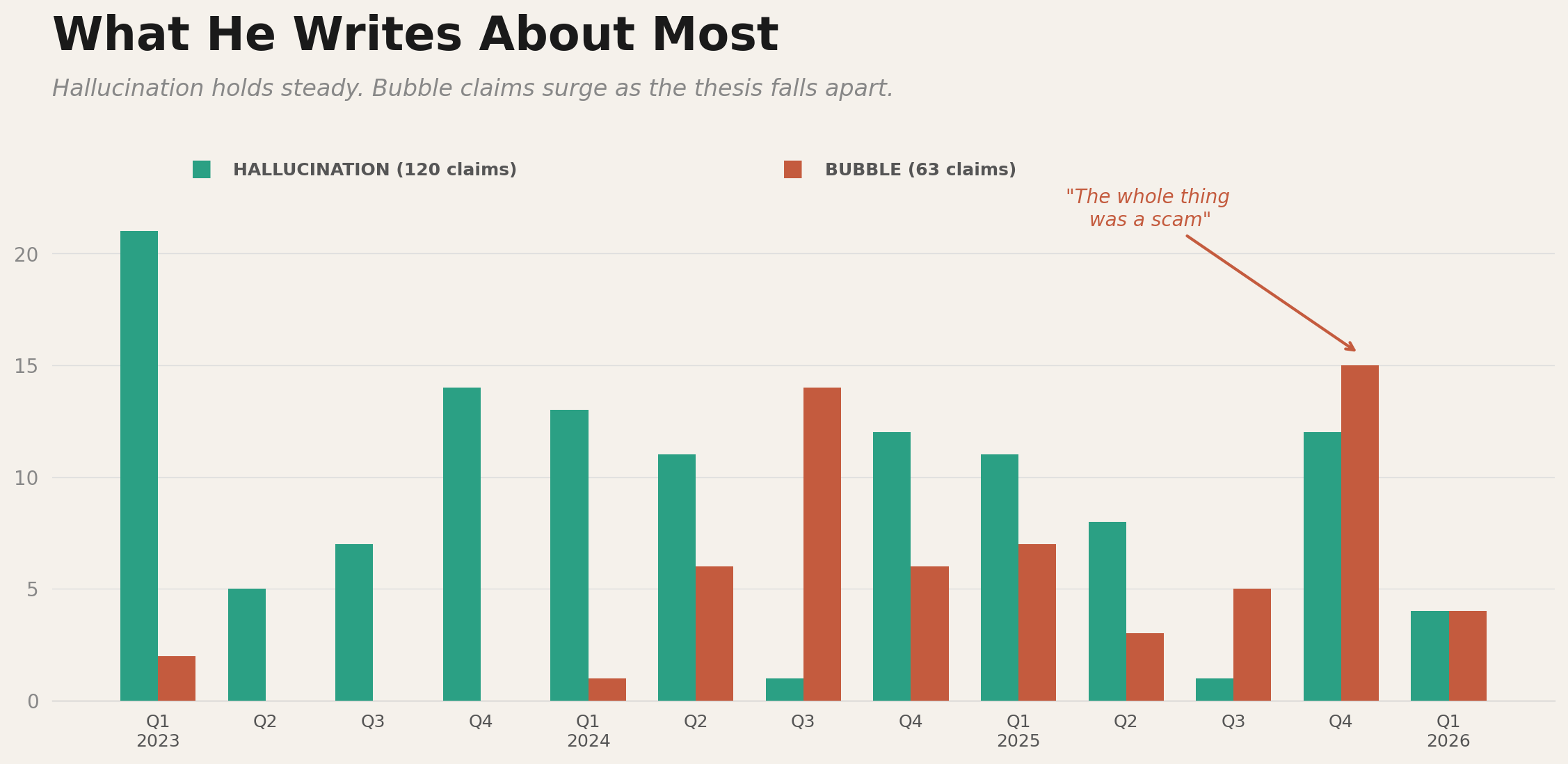
His hallucination cluster, his most vindicated thesis, spiked at 21 when he established it in early 2023, then settled into a steady drumbeat for the next three years. His bubble cluster barely existed in 2023, built through 2024, and hit its highest quarterly output in Q4 2025, right when he published the “scam” pieces. Volume peaked in the same quarter the cluster’s contradiction rate was highest.
Vague claims never resolve, and become your identity.
The Cost of Being Right
Chris isn’t wrong to be skeptical. He experiences the failures every day! Models touching unrelated code; defending bad changes with a straight face; deleting load-bearing parts of the code base then apologizing sheepishly. Those are real, and Marcus gives Chris the vocabulary to take them seriously.
Marcus has been saying AI hallucinates for four years. He’s right. It still does. But two years ago, checking an AI’s answer with a second AI cost so much that most companies didn’t (or couldn’t) bother. Today, that same check costs a fraction of a penny. So companies run every answer through two or three models before a human sees it. The hallucination problem hasn’t disappeared, it’s just faded into the background, like the hum of a new air conditioner.

That’s the pattern across every failure Marcus documents. He names a real problem. The problem persists. And while it persists, the price of working around it drops by half, then half again.
Marcus is correct on a lot of things, but he is the most expensive kind of correct. Right often enough to keep reading, in a way that makes you feel informed while you sit out the biggest buildout since the internet. His readers didn’t miss AI because they were dumb. They missed it because a careful, credentialed scientist gave them permission to wait, and real problems feel like a really good reason to wait.
Chris set a calendar reminder. Six months.
Methodology: We downloaded all 474 of Marcus’s Substack posts from May 2022 through February 2026. Two independent AI extraction pipelines (Claude and ChatGPT, working in parallel) read every post, pulled every testable claim, and scored each one against available evidence as of March 2, 2026. 2,218 claims total, each scored for falsifiability on a four-point checklist: clear subject, measurable prediction, timeframe, and threshold. Claims were clustered into 54 recurring themes and analyzed for repetition patterns, goalpost movement, and trajectory over time.
Disclosure: extraction and scoring were performed by AI systems. Results should be treated as a strong first draft, not ground truth. We recommend spot-checking against source posts for any specific claim cited. Full methodology, raw data, and audit logs are published alongside this piece.